
How does your jaw connect to the rest of your body?
Your jaw connects to your skull, neck and breathing, so how it rests can shape how you hold your head. When your jaw or tongue sits in a different spot, the muscles around your neck and shoulders often adjust to match.
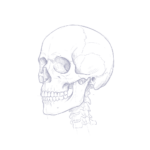
Think about where your jaw lives. It hangs from your skull just in front of your ears. The muscles that open and close it sit close to the muscles that hold up your head. Your tongue rests inside your jaw and attaches to small muscles in your throat. All of this sits right on top of your airway.
So when one piece moves, the others tend to follow. If your jaw slides forward or to one side, your head may tip to balance it. If your tongue rests low in your mouth, you may start breathing through your mouth more. And when you breathe through your mouth, your head often drifts forward to keep the airway open.
I also think about the nervous system here. Your jaw has a lot of nerve endings, and clenching can be one way the body holds stress. When your system feels on guard, your jaw, neck and breath can all tighten together.
Our bodies also aren’t the same on both sides. Inside, we’re built differently on the left and right, from our organs to our diaphragm. Many people chew, clench or rest their jaw more on one side, and that pattern can show up in the neck, the shoulders and even the hips.
What signs do people notice when the jaw and posture seem linked?
People often describe jaw tension along with neck, shoulder or head discomfort that keeps coming back. Many also notice clenching, mouth breathing or a head that sits forward.
Some people wake up with a tight or tired jaw. Others hear clicking or popping when they chew or yawn. Many tell me their neck and shoulders feel tight, often more on one side. Some get headaches near the temples.
Posture clues often show up too. You might see your head sitting ahead of your shoulders in photos, or notice one shoulder looks higher than the other.
Many people I see have already tried a lot. They’ve seen a physical therapist, a chiropractor, a dentist and an orthopedist, and each looked closely at one area without connecting the pieces. That’s often when looking at the jaw and posture side by side starts to make sense.
Can dental work change your posture?
Dental work changes how your teeth meet and where your jaw rests, so some people notice changes in their neck, posture or breathing afterward. That’s why I like people to look at the whole picture before big dental changes.
Braces, palate expansion and bite work all shift the way your jaw sits. Your body is always adapting to where your teeth meet. Even a small change in your bite can change how your jaw muscles work. Some people feel nothing different. Others describe new tension in the neck, a different feeling when they stand or changes in how they breathe.
Dental care matters, and your dentist or orthodontist is the expert on your teeth. What I encourage is asking good questions first. How do you breathe at rest? Where does your tongue sit? Do you clench during the day or at night? Does your head sit forward of your shoulders? These answers give your dental team more to work with.
I work alongside dentists and orthodontists so we can share what we each see. For people who want to learn more before saying yes to braces, expansion or bite work, I created The Dental Fix, a mini course on the jaw, breath and nervous system.
Is there a simple way to notice your own jaw and breathing pattern?
Yes. A simple breathing position can help you notice how your jaw, breath and body feel when you slow down. Use it for noticing and learning, and stop if anything feels off.
This position comes from the Postural Restoration Institute, which looks at the body’s natural left-right differences in our organs, diaphragm and breathing, then uses specific breathing and positioning exercises. I took my first course in this approach in 2018, and I still use this position with people today.
Try this simple check:
- Lie on your back with your feet flat on a wall or a box.
- Bend your hips and knees to 90 degrees.
- Let your jaw rest, and notice where your teeth and tongue are.
- Take a slow breath in, then breathe out slowly and fully. Some people breathe out into a balloon.
- As you breathe out, notice your jaw. Does it clench, shift or stay soft? Does one side of your neck or back feel different from the other?
Pay attention without trying to change anything. What you notice is useful to share with a provider.
When to see someone
See a provider soon if you have sudden or severe pain, numbness or tingling, or pain that started after an injury. These signs need a medical look before anything else.
Call 911 if jaw pain comes with chest pressure, shortness of breath, sweating or nausea. Get care quickly if you have sudden or severe pain in your jaw, face or neck. The same goes for numbness or tingling in your face, arms or hands, and for pain after a fall, car accident or sports hit. Swelling in your face, fever, or a jaw that locks open or closed also needs prompt attention.
For new tooth pain, a cracked tooth or a bite that suddenly feels different, start with your dentist. If you have questions about braces or expansion, talk with your orthodontist. For numbness, frequent headaches or symptoms that worry you, see your doctor. If your vision changes or your eyes feel strained along with neck tension, an optometrist is a good next step.
If those have been checked and your pain keeps coming back, that’s a good time to look at how your jaw, breath and posture work together.
How I look at this
I look at your jaw as one part of a bigger picture, through five lenses: nervous system, vision, teeth and jaw, breath and posture. No single system explains everything, so I look at how they affect each other.
My own background shaped this view. I was a gymnast from age 5 to 22 and then coached. I earned my BS in Exercise Science at SUNY Cortland, where I was also an EMT and EMS Chief. I finished my MS in Athletic Training at the University of Arkansas in 2016 and worked with elite track athletes during that Olympic year. I competed in Olympic weightlifting from 2016 to 2019. Each of those years taught me how one part of the body can change another.
Education and assessment come first. I want you to understand your own patterns before we decide on any next step. I look at you head to toe, and I work with dentists, orthodontists, optometrists, podiatrists and functional medicine doctors so your care team can see the same picture. I co-authored two COVD posters in 2023 on collaborative care between optometry and the approach I use, and I presented at OEPF in 2023 and OVDRA in 2025.
I see people in person in New York City and Long Beach, Long Island, and virtually. If you’d like to read more first, my e-book Beyond TMJ covers root causes of TMJ and the options people explore.